
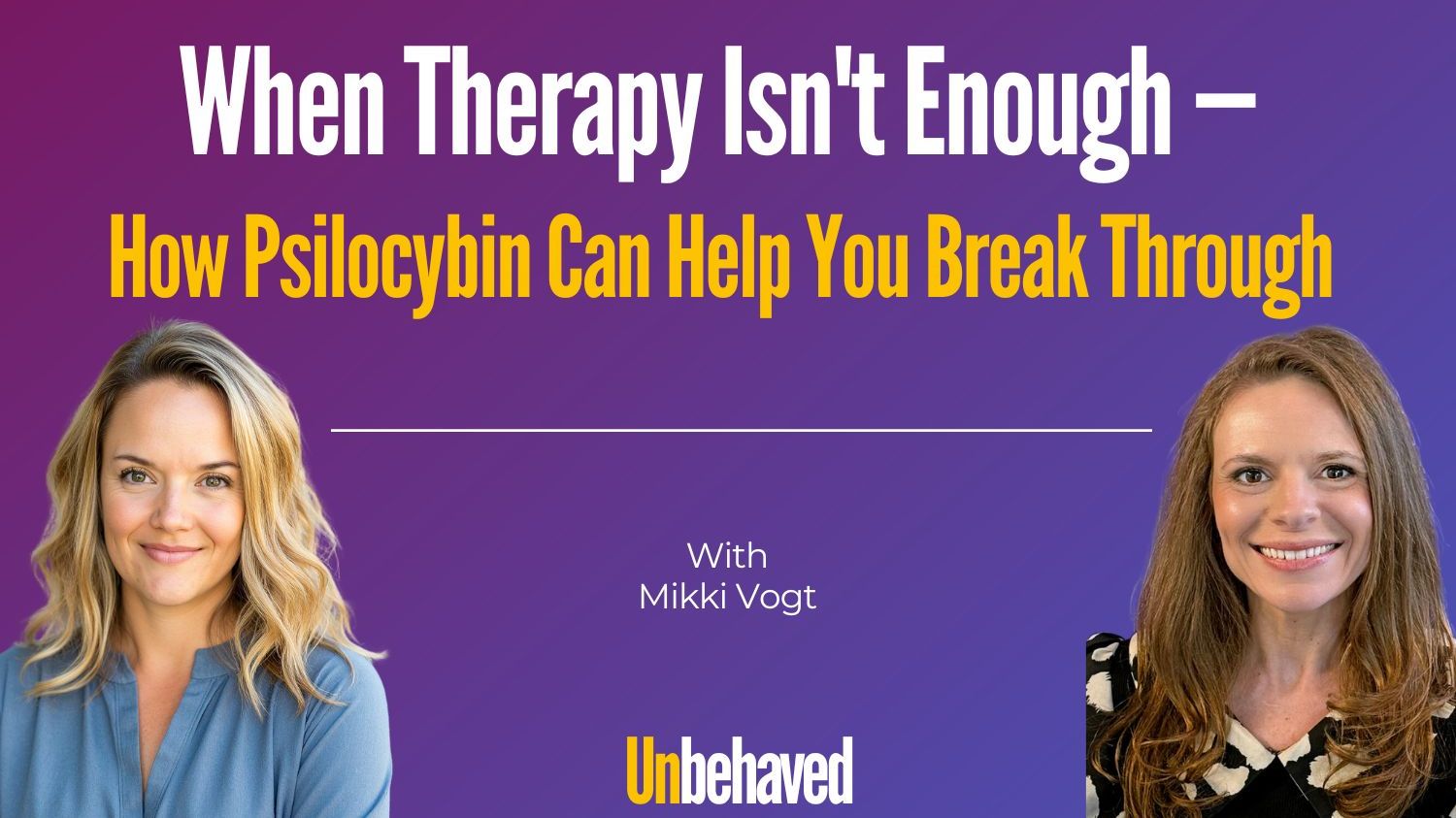
Ep. 18 Unbehaved Meghan French Dunbar with Mikki Vogt
[Listen here 👇]
Or listen on Apple, Spotify, or Podbean.
Episode Overview
A few weeks ago, I laid down on a futon in Denver, drank orange juice with three grams of psilocybin in it, and spent eight hours next to a licensed therapist named Mikki Vogt. Last week I told you what happened for me during that session. This week, you get to meet the woman who held the container.
Mikki Vogt is a licensed counselor, co-founder of one of Colorado's first licensed psilocybin healing centers, and one of the people who co-wrote the safety screening protocols for psilocybin-assisted therapy now used across Colorado and Oregon. Before she was any of that, she spent years working in prisons and community mental health before deciding to start facilitating psilocybin sessions as a harm reduction provider. Before it was legal. When it could have cost her everything.
This is Mikki's first podcast interview. She's spent years training other facilitators and building the regulatory framework other states are now adopting. But this is the first time she's sat down for a long-form public conversation about how psilocybin therapy actually works, why it seems to break through what traditional therapy can't, and what it really takes to make this field safe.
In this conversation, we get into why she made the call to do this work before it was legal, why traditional talk therapy hits a ceiling that psychedelic-assisted therapy seems to break through, the story of a young man who'd had daily seizures for 17 years and what happened during his psilocybin session with her, what a bad trip actually is versus a challenging one, and why the model of legal psilocybin therapy that we're building in this country — the model Mikki helped write — needs public support to survive.
If you listened to Part 1 and wondered how any of this is actually possible, this is the episode that answers that question. And if you haven't heard Part 1 and are just curious about the current landscape and real benefits of psilocybin-assisted therapy, you'll walk away with everything you need to understand what's happening in this field right now.
WHAT YOU'LL WALK AWAY WITH
- Why Mikki risked her professional license to facilitate psilocybin sessions before it was legal
- Why traditional talk therapy hits a ceiling that psychedelic-assisted therapy seems to break through — the rational vs. felt-sense framework
- The story of a young man who'd had daily seizures for 17 years and what happened during his psilocybin session with Mikki
- What a bad trip actually is versus a challenging experience
- The three tiers of adverse events every legitimate facilitator should be trained on
- How Colorado built the first regulated psilocybin therapy framework — and what New Mexico and Oregon are doing differently
- The specific questions to ask a potential facilitator before you commit
- Who psilocybin therapy is NOT for
- Why the model needs public support to survive — and how you can help
PULL QUOTES
"I called my mom and I said, Mom, I just had the most professionally and personally affirming experience of my entire life. I feel like I have finally found where I'm supposed to be, what I was born to do, what my life's purpose and calling is."
"If regulatory agencies don't like the way that I'm doing it, then maybe I don't need the regulatory agency. And that was kind of — I don't know if that was stupid or courageous, or maybe a little bit of both."
"I know I'm smart. I know I'm likable. I know I'm worthy of taking up space. People tell them to me every day. And there is a part of me that knows that rationally to be true. But the belief system that I have developed in experiential, repetitive, time-based learning throughout my life is I'm not worthy, I'm not lovable, everybody will abandon me, and I will never be somebody's first pick."
"Psychedelics are unique in that they seem to be this bridge between what I rationally know insightfully up in my brain and what I at a gut instinct, gut level, feel to be true."
"You can't take the medicine out of the ecosystem and expect it to do the same thing. We need to remember that what we're trying to do is rejoin the ecosystem — we're shifting, not the medicine."
"It's as if I can see an entity or a form trying to push the seizure toward my body." (from the seizure patient during his psilocybin session)
"Any time I go to journey, I'm nervous as fuck. Like, my gosh. And that's great — because that's our nervous system doing its job. It's a reminder that I am functioning the way I'm supposed to function."
"We are self-healing systems — biologically, physiologically, emotionally, soulfully, spiritually. That's how we were created. And we live in a self-healing ecosystem, our world."
"If we want this to be safe, we need to make it familiar. What makes things unsafe is a lack of familiarity."
"It's the mushrooms. Like, you find the person you're connected with who you can trust to keep you safe. But the awareness gained, the insight, the self-love and acceptance — that's your inner healer and the mushrooms. That has nothing to do with me."
CHAPTERS
00:00 — Cold open: "the most professionally and personally affirming experience of my life"
00:28 — Welcome + episode setup
02:13 — Mikki's origin story: her first facilitated session
03:59 — From forensic psychology to prisons and community mental health
08:30 — Discovering psychedelic research and starting private practice
10:12 — Facilitating psilocybin sessions before it was legal
13:12 — Why she risked her practice to do this work
15:21 — Why traditional therapy hits a ceiling: rational vs. felt-sense
19:16 — What the research is showing
22:00 — Why we need to rejoin the ecosystem
23:57 — The seizure story: 17 years of daily seizures
28:52 — The second session and integration
31:00 — Bridging the sacred and the clinical
33:38 — Meghan's fear of vulnerability
35:00 — Mikki's response: "I'm nervous as fuck"
38:04 — Prep and integration protocol
40:58 — Adverse events and the three tiers of safety
43:00 — Bad trip vs. challenging experience
44:43 — How Colorado built the psilocybin program
49:15 — Mikki's role in co-writing the safety protocols
49:34 — Why psilocybin isn't more accessible
53:17 — Business leaders and the mental health thesis
54:44 — How to help others step into this work
57:00 — The funding critique
59:37 — How people can support the work
RESOURCES MENTIONED
- Colorado Proposition 122 (2022) — the framework that made regulated psilocybin therapy legal in Colorado
- Oregon Measure 109 (2020) — the first state to launch a legal psilocybin program
- Senate Bill 290 (Colorado Natural Medicine Health Act) — the legislation Mikki helped shape
- Healing Advocacy Fund — the primary organization advocating for psilocybin therapy access
- Psychedelic Public Policy Partnership (PPPP) — the volunteer coalition Mikki works with
- Berkeley Center for the Science of Psychedelics — psychedelics.berkeley.edu/law
- David Anka — referenced for his framing of psilocybin as reconnection with the soul
Companion episode:
- Part 1 — Why I'm a Mom Who Does Drugs: My Legal Psilocybin Therapy Journey — Meghan's solo episode telling her own story from the inside
Written versions on Meghan's Substack:
ABOUT THE GUEST
Mikki Vogt is a licensed professional counselor, licensed addictions counselor, and natural medicine facilitator with a master's degree in forensic psychology. She's the co-founder and clinical director of one of Colorado's first licensed psilocybin healing centers, has facilitated 300-500 psilocybin sessions over the last five years, and co-authored the standardized safety screening protocols now used across Colorado and adopted in Oregon. She trains other facilitators in psilocybin-assisted therapy through her work with the Psychedelic Public Policy Partnership. She lives in Colorado with her husband and two children. You can find more about her and her work at: https://www.neuroalchemycenter.com
CONNECT WITH MEGHAN + UNBEHAVED
- Subscribe to the Unbehaved Substack: meghanfrenchdunbar.substack.com
- Meghan on LinkedIn: Meghan French Dunbar
- Meghan on Instagram: @meghanfrenchdunbar
- The Book — This Isn't Working: meghanfrenchdunbar.com/book
FULL TRANSCRIPT
Lightly cleaned for readability. Filler words, false starts, and transcription artifacts removed. Mikki's and Meghan's voices preserved throughout.
[Cold Open — Mikki]
The first time I ever did a facilitated session for somebody — at the end of the session, when she was gone, I'm packing my stuff. I get in the car, and tears just started streaming down my face. And I called my mom and I said, Mom, I just had the most professionally and personally affirming experience of my entire life. I feel like I have finally found where I'm supposed to be, what I was born to do, what my life's purpose and calling is.
[Meghan — Welcome]
Welcome to Unbehaved. I'm Meghan French Dunbar, and you just heard from the incredible Mikki Vogt. And if you listened to Part 1 of the series last week — yes, this is that Mikki. If you haven't had a chance to listen to the previous episode yet, Mikki is the facilitator who did my psilocybin-assisted therapy session that I detail in Part 1. But Mikki's story is so much bigger than my experience with her.
Mikki is a licensed counselor and entrepreneur, co-founder of one of Colorado's first licensed psilocybin healing centers, and one of the people who literally co-wrote the safety screening protocols used in Colorado for psilocybin-assisted therapy that have now been adopted in Oregon as well. Before she was any of that, she spent years working in prisons, then in community mental health, before deciding to start facilitating psilocybin sessions as a harm reduction provider. But that was before it was even legal — when it could have cost her everything.
In this conversation, we get into why she made that call. Why traditional therapy hits a ceiling that psychedelic-assisted therapy seems to break through. The story of a young man who'd had daily seizures for 17 years and what happened during his psilocybin session with her. What a bad trip actually is versus a challenging one. And why the model of legal psilocybin therapy that we're building in this country — the model Mikki helped write — needs public support to survive.
If you've been listening to Part 1 and wondering how any of this is actually possible, this is the episode that answers that question. And even if you haven't listened to Part 1 and are just curious about the current landscape and benefits of psilocybin-assisted therapy, you'll learn everything you want to know and more in this episode.
Let's get into it.
The origin story — Mikki's first facilitated session
Meghan: Mikki, Mikki, Mikki. My experience with you is that you are doing the thing that you are lit up about. You're passionate about it, you're excellent at it, and you care about it. How did you come to be in this very unique profession?
Mikki: That is a great question.
I am lit up about it. I'm super passionate about it. It feels like for the last five or six years, I've been living, breathing, sleeping, eating this. And I remember the first time I ever did a facilitated session for somebody. It had been a client of mine who knew it was the first time for me and trusted me to hold that container for her — which was in and of itself just beautiful. And I remember at the end of the session, when she was gone, I'm packing my stuff. I get in the car, and tears just started streaming down my face. And I called my mom and I said, Mom, I just had the most professionally and personally affirming experience of my entire life. I feel like I have finally found where I'm supposed to be, what I was born to do, what my life's purpose and calling is.
That was probably about six years ago now. And I had told myself, not everyone you do is going to be like this. Over time, it's not going to be as exciting, it's not going to feel the same way. And I was so wrong. Every single one of these I do is beautiful and profound. The connection I have with the journeyer is probably one of the greatest gifts I'll ever experience. And getting to witness such a sacred experience for them is just such an honor.
Every single one, it fills me up. I'm super jazzed. I'm rejuvenated. I come home on a total high. And I haven't even touched the medicine myself.
So I absolutely love what I do. I would have never thought that I would be here.
From forensic psychology to prisons
My master's degree is in forensic psychology. And so when I first started working in the field, I was primarily working in prisons, jails, correctional facilities, community re-entry programs — working with really severe pervasive mental illness, dual diagnosis, co-occurring substance abuse disorders, incarceration, all of that kind of stuff. High rates of recidivism, high rates of homelessness, high rates of emergency system use.
So I got to work with the real nitty-gritty. And in doing so, I got to create these amazing relationships with populations that are so typically unseen and disregarded and stigmatized. In getting to work with these individuals, it really was a reminder that we are all just human — trying to survive, trying to make our way through this planet and the life that we're dealt.
These people are just like you and me. They have learned a set of coping responses. They have learned how to survive in a way that keeps them moving forward. And while the behaviors they've chosen might be maladaptive and cause a lot of consequences, the need is relevant. If we can see them as humans with relevant needs that are the same as yours and mine, all of a sudden they're not this bad, terrible person. They're somebody who has been wounded by society and needs repair. Needs support. Needs to be seen. Needs love and affection and attention.
When they start to receive that, it's a completely different version of them that you get to work with. That was just a totally amazing experience for me, and really confirmed why I do this work.
At some point, I did get really tired of going to prison every day for work. I am a colorful person. I'm very bubbly. And it really started to wear on me — going through the whole check-in process, hearing the gates and the bars closing behind me, being in this drab, poorly lit place. It got to be a bit overwhelming, and I started to burn out. Which wasn't fair to the people I was working with.
Transitioning to community mental health
So I decided to transition into community mental health — high-intensity treatment settings and community-based services. Very similar populations, still did a lot of the community re-entry stuff. Where I was getting to work with people I had worked in corrections with as they were coming out. Supporting them in stabilization, mental health treatment, housing, vocational support.
That was where I really got to see the power of interdisciplinary wraparound services and how important community is, in general, for health and wellness.
During this period, I started tracking all of the research going on with MDMA and veterans and PTSD. I was blown away by some of the outcomes we were seeing. I was facing a reality that I really wanted to work in that psychedelic realm, but was not going to be able to do so within community mental health — that's all state government funding and evidence-based practices, and that's not where psychedelics were at the time.
So I started to develop my own private practice on the side. Not working with psychedelics yet — just building a practice, learning how to manage it, figuring out the ins and outs of being a business owner. Because as a clinician, I'm not inherently an entrepreneur — which people find very surprising when they meet me and are like, wow, you own three businesses. That's definitely been the hard way. Which seems to be my forte: doing things the hard way.
Right before COVID, I fully transitioned to private practice. Never looked back. Got myself credentialed with insurance and Medicaid because I still wanted to promote accessibility. And then really dove into research on psychedelics — experimenting with my own relationship.
The underground practitioner experience
I got to have a really beautiful experience with an underground practitioner who held space for me. Such a transformative experience. I'd used mushrooms, MDMA, psychedelics before, and already knew there was something significant there. But then having that specific container being held in such an intentional way — I got to see what the outcomes can be when you bring intention and mindfulness into it, have the safe space to have the experience, and then really focus on integration afterwards.
It's also an experience that taught me some of the risks of doing this in an unregulated setting. Coming to that as a clinician, I'm familiar with best practices and ethics, and wasn't seeing all of those being championed in that space. I felt like — okay, yes, I really want this for my clients, but I want to do this in a way that is ethical and safe.
So at that point I started hammering out my own safety screening protocols in alignment with what I'd been taught as a therapist and addictions counselor. Looking at the research about drug interactions, doing my best to screen out anybody that wasn't relevant for this. And at this time I only started to offer this to clients in my private practice who I'd been working with for quite some time.
Meghan: Is it still technically illegal at this point?
Mikki: Technically, this was not yet decriminalized. And so I was doing this as a harm reduction provider as an addictions counselor. I would go into details with my clients about what that meant, what kind of services I was providing, clarity that I'm not the one giving them the medicine — the medicine is being sourced from somewhere else by them, and they're just asking me to sit with them for harm reduction purposes. All of those things to try to keep it as up-and-up as possible.
Why I risked my practice
When people were asking me, well, what if you get grieved? What if you get reported? I said, that's a risk I'm willing to take. Because at that point I was taking significant safety precautions, had consulted with other people to really understand the risks I was taking on when it came to health and wellness for the clients I was working with.
At any point, the client being considered was only pursued if I felt very strongly that the potential benefits outweighed any obvious risks after doing all the screening and assessments. In the idea of taking an oath to do no harm, my thought was: if I've been working with a client for so long and they've tried treatment with me and treatment with others and different modalities and haven't gotten to where they want to be — and I've now screened them and shown that the risk of doing this is significantly low and the potential benefit is there — then would withholding something I know would work and wouldn't be harmful itself be doing harm?
In my head, it felt like it would be.
If I know something works, and I know they're eligible for it, and it's not going to put them in danger — why wouldn't we try it? Especially given psilocybin has such a high safety profile. It's one of the safest molecules we have. It's even safer than Benadryl. It doesn't have any risk of dependence. There's no risk of overdose. It's not going to give you stomach ulcers or ruin your kidneys like Tylenol. If we're so willing to put all these other things into our bodies without a second thought — why wouldn't we use a natural medicine, plant medicine that is shown to have one of the highest safety profiles?
It just didn't make a lot of sense to me. So that's where I decided: I came here to do a job. I came here to help people and support people and see them as a person, not just a file or a client number. And I'm going to continue doing that. And if regulatory agencies don't like the way I'm doing it, then maybe I don't need the regulatory agency.
And that was kind of — I don't know if that was stupid or courageous. Or maybe a little bit of both.
Meghan: Those are the best decisions, in my opinion. And this is the first time I'm hearing this story. I feel in awe of what you did, because you were so convinced of the efficacy of this and you understood the risks and you understood the literature — but you were putting your own private practice on the line to do this.
Mikki: It took — yeah, it took... I mean, there were definitely moments where I was questioning why am I doing this? And what kept coming back to me was: because I really believe in this.
I didn't start doing it with people until after I'd already received training. At that point we didn't have DORA-approved training programs, but there were absolutely training providers out there for harm reduction purposes providing courses in psilocybin and harm reduction services. So I did a lot of training from various different providers. A lot of apprenticing, shadowing, seeing how other people were doing it. A lot of understanding of the indigenous roots of the medicine — what does ceremony mean, who am I and who am I not, what is my own lineage with natural medicine.
I really explored all of those things before ever feeling like I was in a position where I could confidently do this with somebody else. So by the time I did start doing it, I felt pretty convinced: if I'm going to get reported or grieved, I have a good argument. And if they decide they're not on the bandwagon with this, then I'll find a different way to make a living.
I don't know. I say that out loud and I'm like — and I'm a mom and a wife, and they probably were not very appreciative that I was willing to risk everything.
Why traditional therapy hits a ceiling
Meghan: That also speaks to how powerful this is. You talked about your first time facilitating and calling your mom and crying. What did you experience in those first few sessions in terms of the healing that people were able to do that felt so different than all the work you'd done before?
Mikki: What I was getting to see is — in traditional therapy, even when we start using somatic experiencing therapies like EMDR, where we're really trying to approach the whole system, not just the cognitive approach — it seemed like you would get to this point where we have the insight.
I know I'm smart. I know I'm likable. I know I'm worthy of taking up space. I know I can be successful. I know I'm competent. I know I'm significant. I know these things up here. People tell them to me every day. And there is a part of me that knows that rationally to be true.
But the belief system that I have developed in experiential, repetitive, time-based learning throughout my life is not the insight. The belief system is: I'm not worthy. I'm not lovable. Everybody will abandon me. I will always have to try again. I will never be somebody's first pick.
Right? That's the felt-sense belief. Which is ultimately what ends up guiding the way we experience ourselves, others, and the world around us. We see everything through this colored lens of the belief system — not of rational insight. There's this disconnect.
EMDR seems to get us a little bit closer to bridging those two things, but I was still finding that clients were falling short. Maybe I'm just not doing the EMDR effectively — I don't want to blame any modality for not working. There are so many great modalities out there. But I think psychedelics specifically are unique in that they seem to be this bridge between what I rationally know insightfully up in my brain and what I at a gut instinct, gut level, feel to be true. In my nervous system, in my body, in my heart, in my soul.
When we can bridge those two things, all of a sudden I'm able to experience myself, others, and the world around me in a completely different light. I'm able to engage with information that has always been up there, but see it in so many different ways. My consciousness now has become so expanded that I can consider so many different things and choose what I want for myself. Not feel like I've got these blinders on that only allow me to see one path forward.
That's what I think is so profound about psychedelics. And what I love is that the research is showing this. It's going in and creating this high level of entropy or chaos in the brain, which is allowing us to break free of all these rigid belief patterns, neural pathways, and connections that dictate how we organize information about the world and ourselves. We ascend above that. We get to see everything as fluid and say — how would I like to organize information moving forward? Not this is the way, I have to believe this.
Sometimes that's small things. Sometimes that's huge things — the philosophical meaning of life versus the routine I want to engage with every morning.
Acknowledging these other modalities, I really think that psychedelics is one more tool in our tool belt that should be used in conjunction with other approaches to transformation, healing, expanded consciousness. If you're going to get trained in something like IFS or somatic experiencing, why not also get trained in this? It's not for everybody, in the same way that those modalities are not for everybody. It's just one more tool.
What the research is showing
Meghan: All right, I want to keep going on the research part. Is there anything research-wise that blew you away at the start that you were like, I have to engage with this? What is the research telling us?
Mikki: I was really lucky in that I got to work as a therapist on the CU Anschutz clinical trials focusing on using psilocybin to address depression and existential distress related to end-of-life and cancer diagnoses. That's where I really got to see how this addresses more existential experiencing — the things that contribute to some of the distress we walk through life with.
What is the meaning of life? What does it mean to live a full life? What does it mean to die? What is a legacy? What do I believe happens next? What do I believe makes this life worth it? Who do I want to be in this world? How do I want to be remembered?
All of those things come up in these sessions when that's the intention. And in that clinical setting, it was profound. I got to witness people going from this place of severe depression and just devastation and defeat to feeling like they could go through the active stage of dying — because that's just one stage of our cyclical life — with agency, with hope, with optimism about what that process was going to look like, how it was going to feel, what values they were championing during that process.
They weren't just focused on the end. They were focused on processing time left. That really changes a lot of things for people.
The other thing with the research: these individuals are coming in with a significant sense of hope, and in these double-blind, random control trials, they may or may not be getting the medicine. There's a fifty percent chance they're going to end up in the placebo group. So it was also a reminder of how hopeful other people are — that even at that point in life, they're willing to engage with this, not knowing what outcome will be for them, just because they're hopeful enough.
That's a big chunk of the research — end-of-life palliative care. But we're also seeing research in PTSD, depression, anxiety, eating disorders, traumatic brain injury. Dementia and Alzheimer's. Chronic pain management like fibromyalgia and chronic pain from injury. Regaining movement after paralysis from West Nile virus. Seizure disorders.
There's research coming out about so many different areas that when people say, what can you use this for?, I'm starting to find the list is shorter to acknowledge what we probably couldn't use this for. Which is exciting.
I say that with a caveat: these medicines have been stewarded by peoples for thousands and thousands of years. It's an ancient wisdom and an ancient practice. And the molecule is not doing this alone.
Rejoining the ecosystem
In all of these settings, but specifically in the original — the OG, where did this come from — what makes this profound is the community. It's the preparation, the container, the integration happening afterward. It's the connection with self and others. It's experiencing that you matter in a greater system, that people see you, and that your transformation is worthy of being witnessed.
When you look at indigenous cultures who have been doing this — we talk about prep and integration. It's not talked about there, not because it's absent, but because that's the lived experience. They do this in a communal setting with family members, with community members. Their living preparation, then their living integration. It's built in. They wouldn't consider doing this outside of that. They wouldn't consider just going into the doctor, taking it, and then going home and not talking to anybody about it.
We use this language — prep, integration — as a way to streamline this into the system we're familiar with. But we have to understand that we can't use natural medicines, which work in an ecosystem we are a part of, and expect to take the medicine out of the ecosystem and have it do the same thing. We need to remember that what we're trying to do is rejoin the ecosystem. We're shifting — not the medicine.
The seizure story
Meghan: You mentioned epilepsy. And at the end of our session together, you were telling my husband and me a story about a gentleman you worked with with epilepsy. I would love to help bring the research to life a little bit. Can you help us understand what happened?
Mikki: Yes — and I want to put out there, this is anecdotal. And it's profound.
This gentleman contracted an infection — an illness that turned into a brain infection at the age of 10 or 11. With that, he started experiencing severe seizures. Five, six seizures a day. Full seizures. Totally disruptive to his life.
His family took him to doctors and treatment teams. He went through all this imaging. Different medical teams were in disagreement about the origin site of the seizures. You'd think they would have approached this with conservatism since the boy was so young and they didn't really know what was going on. Unfortunately, what we think should happen is not always what happens. This poor gentleman went through three brain resections and five depth probes — all before he was 13 years old.
It did not make anything better. It only made things worse. It severely slowed down his cognitive processing. It made it so he couldn't get through a whole day of school. It really disrupted life.
Now he's in his late 20s. He's been dealing with this for 15 to 17 years — daily seizures.
He tried different medications. He finally got on a medication that reduced the seizures down to two or three a day. Significant improvement, but still not great. And then his neurologist had been reading about psilocybin and the potential of what it's doing. His neurologist and his parents reached out to me and said, how do you feel about working with him? We know you can't guarantee anything, but per what the neurologist was reading, it might be interesting to try to do this once every three months and see what might happen.
So I started working with this individual. We did a lot of prep. For this individual, it wasn't like two prep sessions and then we're in. We did a lot of prep. I got to know him, his family, his story, his background — what his dreams and aspirations were, what supports were already available, what he wanted life to look like moving forward. Truly amazing individual.
We got to his first administration session, December 2025. I had gone over the safety plan and emergency response plan for if a seizure starts during the session. His mom stayed on site. I had direct contact with his neurologist. We had all the safety things in place.
We get an hour in, and he is smiling and relaxed in ways I've never gotten to witness him in the last several months. It was beautiful.
Because of that, we're like, let's go ahead and do the booster. So we give him a small booster dose. And within about 15 minutes of giving him the booster, I witness his body seize and just lock up. He does this quick inhale. And I'm thinking in my head, oh God, here we go. I'm getting really nervous.
Per our safety plan, his mom had said, don't administer the emergency medicine until the seizure has lasted longer than five minutes. So I see him lock up. I see the breath. I see his eyes glaze. And I start the timer.
Here's what's interesting. Up to this point he had been talking to me with his eyes closed. And he said: "It's as if I can see an entity or a form trying to push the seizure toward my body." And then he seized. He locked up. He starts to seize and twitch.
Eight seconds go by.
And it stops. He breathes out. And he says: "And I'm able to just push the form away from my body, and it pushes the seizure out."
And then he dropped back into his journey.
Which had nothing to do with his seizures. He journeyed for the next six hours with no seizure at all. Completely calm. His body completely relaxed. His hands — he had one hand that was really tight and painful. By the end, it was completely loose and he was using it, saying my gosh, my hand.
Between that session and March, which is when we did his second session, he had one seizure. One.
We did his second administration in March. Almost the exact same thing happened. First hour in, everything's great. I give him a booster. About seven minutes after the booster, we see the seizure onset. I start the timer. Eleven seconds in, it's finished. And he drops back into his journey.
I've been doing ongoing integration with him, working with his neurologist. It's an ongoing care plan. He's got a lot of wraparound support. He's in vocational stuff, art, a coding program. Part of that integration is that while he's in that state of neuroplasticity, we're really putting in all the other supports that are going to benefit him in learning new skills and starting new behaviors. And it's just been profound. The outcome — he's now in a coding program. He's teaching art classes. It's really amazing. Truly amazing.
Meghan: With the seizure he had between the first and second sessions, even though he wasn't using the medicine — was it still the same experience for him where he could see the entity and push it away?
Mikki: Yes. Yes. In integration I had him draw out the entity — the form he had seen. It was like this metal sphere thing. He drew it out, and we started doing imagery exercises. When he starts to feel the aura or the tremors — because there's always some kind of sign — he starts imagining the form he saw in the journey bringing the seizure to his body. And he immediately starts this imagery of pushing back toward it, both physically and energetically.
The seizure he had between sessions, we think was actually brought on by significant heat. He was at the gym, sitting in the sauna. But that one lasted for maybe two minutes, and then he was fine.
Bridging the sacred and the clinical
So this is where I like to acknowledge — we need to bridge the sacred with the clinical.
I think that's a really good example. We can say we're going to be able to see a lot through science. Through imaging, blood work, pre- and post-measurements, assessments, evaluations. That's amazing. And ultimately, there is something at work here that is ancient and profound and sacred that I truly believe will never be caught in an image, will not be caught in a random control trial. There is something greater that happens when you reconnect with Earth and the ecosystem you're a very natural part of.
When we're in right relationship with the system we originated from, that in and of itself is going to change how we're experiencing self and the world and our health and wellness.
We know that mindset is profound. We look at a lot of research where cancer patients who have a really hopeful mindset and do a lot of visualization during chemo — their prognosis is better, they have better outcomes. Whereas those who go into it with a really poor mindset and have succumbed to defeat don't get the same results.
There is this piece of how connected do I feel with this? How much do I believe in it? And also realizing again — it's not just the molecule. It is our relationship with it and what we're willing to do. Are we willing to be a contributing party to our self-healing?
Are we willing to acknowledge and return to the reality that we are self-healing systems? Biologically, physiologically, emotionally, soulfully, spiritually — we are self-healing systems. That's how we were created. We live in a self-healing ecosystem, our world.
It's only been in recent hundreds of years that we've started to externalize this source of expertise — on how many letters are at the end of somebody's name, so they can tell me about me instead of my body and my mind and my soul telling me about me. Now I need somebody who's gone through eight years of medical school and who doesn't know me, but they're going to tell me about me.
Instead of saying, no. You know what I'm gonna do? I'm gonna work with this natural medicine that is of the earth, that has really low risk to it, and I'm going to unlock communication with that medicine with my inner healing wisdom. And the medicine and my inner healer are going to do for me what needs to be done. And they're gonna show me what I need to do to use insight and awareness gained and turn it into embodied lasting change.
That's the work that I will do.
Meghan's fear of vulnerability
Meghan: So I did a journey with you, and I've talked to quite a few people about it because for me it was profound. When I talk to people about this, a lot of people say — I want to contribute to my self-healing, but I'm afraid of letting go of control.
I understand that. Especially if you've never even experimented with these things recreationally. Which I had beforehand — so I had some level of comfort. And I was like — so Mikki, you're saying you're going to give me the largest dose of mushrooms I've ever had in my entire life, and then I'm going to sit with you in a room for six to eight hours while you are stone cold sober, and be just tripping balls and like the most vulnerable version of myself. And you're just going to sit there and watch me?
I was like, I am not comfortable with that level of vulnerability. And you were like, this is what I do. You helped me work through it. So for the folks who are on the I don't want to let go of control, I'm terrified of being that vulnerable in front of another human train — what do we say to them?
Mikki: I would say — that checks out. You're human.
If you're not nervous at all about this experience, I kind of ask you — are you familiar with what we will be doing?
Even in my shoes, when I think about being the journeyer, no matter how many times I've done this — facilitated or journeyed myself — any time I go to journey, I'm nervous as fuck. Like, my gosh.
Even in my head, there's that rational part, the insightful part that says, Mikki, you've done this, you're familiar with it, you know what it is, you're gonna come out on the other side. But then there's the felt sense that's like — but I'm giving up control, and I don't know where I'm going to go, and I don't know what I'm going to see, and I don't know if I feel equipped for that.
And I don't. It's all the uncertainty that inherently breeds anxiety. And that's great, because that's our nervous system — from an IFS perspective, our protectors doing their job to protect us. It's a reminder that I am functioning the way I'm supposed to function.
In that place, I say — it's good that you're nervous. It means that you're invested in this. You care about your wellness and well-being. You want to be careful that you're not doing something in which the risk outweighs any benefit.
That's why I'm here. My role is to promise that I'm going to do everything I can — screening-wise, preparation-wise, day-of and follow-up — to ensure that you're having the safest experience possible. That we're minimizing as much harm and discomfort as possible. Giving you a safe container in which you can shift your relationship with distress. So that that idea of not always being in control is not as scary moving forward.
Not being in total control in and of itself is not a life threat. Is it anxiety-provoking? For sure. There are a lot of variables I need to be prepared for that I don't control, but I need to be able to respond to. But when we can change our relationship to distress and say — distress in and of itself is not a bad thing. When I respond to distress effectively, the way I'm supposed to, distress is helpful — I don't need to get distressed that I'm distressed.
That's the importance of prep.
What I'm hearing you say is — you don't trust me enough yet to be that vulnerable in front of me. That's fine. Let's do a few more sessions. What do you need to know about me? Would you like to meet here in the space where we're going to journey? What do you want to know about my background, my relationship with medicine?
Let me walk you through the approach and what's going to happen the day of. What do you need to feel ready? What do your parts need to feel ready? What are your protectors saying they're concerned is going to happen? Let's address that directly, so that the whole system of you is coming on this journey — and that we are, for the first time in your life, not steamrolling any part of you and making them suck it.
Prep and integration protocol
Meghan: Such a way of putting things in a way that my brain is like — thank you. So my experience: we did three prep calls on Zoom where I literally came with notes. Here's all the intellectual insights I've done in six years of therapy. I have them in chronological order. Here's all my garbage. Then we did a full day of the plant medicine. I arrived at nine. I left around 3:30 when my husband picked me up. And then we did three integration Zoom calls afterwards. Is that pretty standard?
Mikki: My bare minimum that I insist upon is two prep, two integration. The container, I think, is the most crucial part of this experience. How well are you prepping them for the experience so they can be equipped to navigate any uncertainty, any destabilization or dysregulation that happens. And then the integration — they know they have support, they can talk about the awareness gained, the confusion of anything that came up. They can create meaning.
You work together to create a tangible plan for movement forward. How do I want to apply this awareness? What am I changing in a day-to-day that will help me embody greater change, a higher quality of life, a more fulfilling experience?
Minimum of two on each side. Ideally, I believe that three to four integrations is absolutely wonderful. And it's about having community. Even if you're not doing more than two to three integrations with me, we've got you set up in a community that supports you — where you have places and other people you can talk to about it and process through it. Whether that's another therapist, a coach, a yogi, a best friend, a community integration circle that meets once a month.
A community activity where you've got individuals who are like-minded, and as you're transforming and becoming what you want to be, a community that's going to support you in that — and not question why you need to change, but just cheerlead the change.
Okay, I'm seen. I'm heard. There's a place for me to go, and I'm a part of something greater.
The integration is huge. The community piece — having a psychedelic family — I think is one of the most important parts. I've said this before: we're going to treat an individual over and over and over again. We're going to continue to do the same thing over and over until we treat the community that continues to wound the individual. If we're not approaching this in a community way, we're not learning anything from the medicine.
Adverse events and bad trip vs. challenging experience
Meghan: So how many journeys have you facilitated, and through all of those, have you ever had a negative response — health issues, calling the hospital, something very bad?
Mikki: Over the last five years, I've probably facilitated somewhere between three to five hundred sessions. Some have been repeat journeys where we've done multiple sessions; some are people who only do it once or twice.
When it comes to adverse events, what I teach my learners is that there are three tiers you want to consider.
The first is acute expected effects of psilocybin. Things like transient high blood pressure, feelings of queasiness, feelings of anxiety, distress, crying, sadness, grief. Yes — in fact, I'm hoping some of these things happen for you so we can change your relationship with distress. I don't want you to have a terrible time. I want you to have a meaningful time. So I'm hoping for some of those things.
Then it's when you take a lot of those acute expected effects and they become very severe, or you've got a combination of them — sweating, higher blood pressure, flushing in the skin — where then I'm like, ooh, do we have a cardiovascular event risk right now? This is where you need to use clinical judgment, listen to your intuition, know their medical background and history, have done all the consulting and safety clearances. So you can determine when an acute effect combined with other things or heightened in severity becomes an adverse event where there needs to be some type of intervention.
Then what takes that from an adverse event you're dealing with in the session to a reportable adverse event — calling DORA, calling EMS, getting outside emergency medical services involved. That would be a full-on adverse event. I've never — knock on wood — had to do that.
If you're diligently following best practices and ethical standards, screening, considering background, asking about medications, asking the hard questions, and not facilitating through a scarcity mindset — meaning you're willing to say no to people — that's not going to happen. You've screened out the possibility for it to happen. So I've never had to deal with that.
I think there's a difference between a bad trip and a challenging experience. And again — set and setting and prep and integration are the biggest factors that delineate between those two things.
You're likely going to have a challenging experience with me. I hope you do. That's really what I want you to have.
What we do with that challenging experience is what makes it not a bad trip. The way I respond to you in your challenging experience and support you in that moment. What we do in integration with that experience — finding the meaning in it, how we're using the awareness gained. That's what makes it not a bad trip.
A bad trip happens when we're not in a safe container. We don't have somebody who's holding space for our safety. We have mixed it with other substances. We haven't set an intention. We haven't gone through informed consent. We don't know what the risks are. We don't know how much we're taking. We don't know if the medicine is pure or what its potency is. We don't have mental health support. We have nobody to talk to afterwards.
That is the recipe for a bad trip. That's not what we work on in the regulated space.
How Colorado built the psilocybin program
Meghan: Speaking of the regulated space — I believe Colorado, Oregon, and New Mexico are the only places where we can do this at this point. How did this come to be? How are we so lucky to be in Colorado? And what was your role?
Mikki: We passed Senate Bill 290 back in 2022. That established the Natural Medicine Health Act, which decriminalized psilocybin among four other natural plant medicines and set up an advisory board to create the regulated program.
What sets us apart from New Mexico is that we don't do this in just a medical or clinical setting. You don't have to have a diagnosis to do this. There doesn't need to be a referral from a treatment provider. You can come for spirituality purposes, consciousness expansion, personal transformation. You don't need to be pathologized in order to be relevant.
I love that about how we've set that up. Psilocybin is not supposed to be a mental health medicine. It never was. It's not here to treat mental health. It's here to reconnect us with the soul that we are, and the light that we're here to shine — quoting David Anka. That's what psilocybin is supposed to do. It's not about resolving a diagnostic pathology.
We started with that bill. Created the advisory board. Set up the regulations. Got the program started. It went live January 1st, 2025, when people were able to apply to be licensed facilitators. They could apply as natural medicine businesses to get licensed as healing centers, cultivators, manufacturers. You can get a licensed natural medicine handler license to provide support services in a healing center.
There are all these different roles you can play within the system. DORA oversees licensing for facilitators and training programs. The Natural Medicine Division at DOR oversees licensing for natural medicine businesses — healing centers, cultivators, manufacturers. So DOR is the business side. DORA is the individual side and the education side. Those two agencies have come together and are overseeing.
We've also brought in Colorado Department of Public Health and Environment. They do the data collection for the program and oversee licensing for testing labs. All regulated medicine goes through testing, so we understand the purity and potency of each thing and know exactly to the milligram how much medicine we're giving an individual, and how much of the other alkaloids are present.
Mikki's role in the safety protocols
I came into this having been working on the research at CU Anschutz. I became a part of an organization called the Psychedelic Public Policy Partnership — PPPP, lots of Ps. All volunteers, passionate about this, believing in it, volunteering our time. We started doing white papers and research to help advise and inform the advisory board on the regulatory rules and requirements.
Then I took the safety screening I had already created in my private practice, and with two other volunteers — Erica Messenger and Kristen Speer, two women I have a lot of admiration for — we co-authored the standardized safety screening now used throughout Colorado and adopted by Oregon. Erica is in medicine and Kristen is in pharmacy, so they built out the pharmacological and medical areas while I continued to build out the mental health area.
We really promoted that being something that was always going to be free and available — not a for-cost thing. We wanted to reduce anything that was going to increase barriers to access.
Now there's a board overseeing the updates and maintenance of that screening form. Because psychedelic research is moving quickly and we're learning new things every day. That form at the minimum is going to need to be updated on an annual basis. We've got this board committed to doing that.
Meghan: You volunteered to do this. You have your own business. You have kids. You are just like everyone else — very busy. And you believe in this so much that you decided, yeah, I'm going to volunteer my time to make sure this is as safe as possible. Thank you. Period. Thank you.
Why psilocybin isn't more accessible
Meghan: Why isn't this more accessible in the United States? Why are we one of the only states that has this?
Mikki: There are a lot of reasons.
From a policy legal standpoint — we had the war on drugs and all these substances got put on the FDA's Schedule One. I could go into the politics and theories behind why psilocybin ended up on that list, but that's a completely different podcast episode. Psilocybin is considered a Schedule One substance by the FDA and so is federally illegal, and has not yet been rescheduled. So it's on a state-by-state basis that we're creating these acts and regulatory programs — that the state is approving under the awareness that federally, it's still illegal.
For doctors who hold DEA licenses, there's a level of liability and risk that some people are just not willing to take on. Which I completely understand.
I also think there's a huge stigma against psychedelics because of the war on drugs era. The propaganda that was put out — ice cream scoops out of your brain, your brain melting into your spinal cord, this is your brain on drugs, the scrambled egg. That's not true. But we were so inundated with that. Previous generations were so inundated with those images and beliefs, that's what was taught to us: this is a drug, drugs are bad, this is going to kill you.
Part of what we're having to do is this whole education initiative. Overcoming the false stigma, the false narratives about what this is, what we're doing, why it's useful, and the context in which it's relevant.
You'll never hear me say this is not relevant in a fun social recreational setting. Psilocybin at a musical venue, listening to some soulful thing, is going to be extremely powerful and profound all on its own. Be with people you trust. Be in a safe setting. Know what you're doing beforehand. Get it from a trusted source. Test your medicine. All the things.
That is still a relevant experience. But it's acknowledging — you're not coming to your therapist's office or facilitator's office to party. That's not what's happening. Your facilitator is not engaging in the medicine with you. We're not raving. There are no light shows. You've prepped. We've come to intention. You've created a really deep connection with your facilitator, who is holding this safe container for you. And you're journeying inward.
It's not about your external environment. You've got the eyemask on. You've got the headphones on. There's no wrong way to journey — you can take those off, it's fine, but it helps you drop in. You're journeying internally. You're going to places within you've never been before. You're peeling back the veil so you can see beyond the rigidity of what has been propagated unto you.
I think there are groups out there who do believe in some of the old information, and so they are afraid — afraid for their kids, for their animals, for their communities. I get it. We're afraid of the unknown. Understandable.
We just need to educate. And no — it's not for everybody. This medicine, like anything else, is not for everybody. There are some people who won't respond well to this and shouldn't be messing with it. They will find that out in the regulated setting. Whereas in the unregulated setting, there's a high risk they won't — until it's too late.
Business leaders and the mental health thesis
Meghan: The thing that comes over me when I bring this back to my work of business leaders and making work better is this statistic: 70% of people say that their manager or leader at work has as much or more of an impact on their mental health as their spouse does. And we have a lot of people heading into the workplace, in charge of other people, who have not done any healing work themselves. So they're bringing their own shit into the office. And that disproportionately impacts the people around them.
I've had people be like — my God, are you going to talk about this on the podcast? I'm like — absolutely. Because for me, when you talk about reconnecting with the soul — there were lingering pockets of deep insecurity that I have held, that I've been aware of, that I have not been able to extricate myself from through six years of therapy and EMDR and all these things. No matter what I do, I am still bringing those into professional spaces. How I respond to people. The way I'm showing up in the world.
If I can't heal those parts of myself, it is going to impact the people around me. We know it's effective. We're watching how much this is healing people. There's tons of data and research and anecdotal evidence. How do we convince other people? And I'm not being like — how do we browbeat people into doing this? But for someone listening who's like I don't know what people are going to think of me, but I'd like to try it — how do we help them step into this and do their own work in this way?
Mikki: It's things like what we're doing right now — talking about it openly and calmly and without fear. Having the recent legislation and policy and programs that have been created is a major help. It legitimizes and gives credibility to what we're doing here. It makes professionals more willing to speak freely about what they are and have been doing for a while.
We need to talk about this just like we talk about any other medication or substance — with ourselves, with our kids, with our coworkers, with teachers.
If we want this to be safe, we need to make it familiar. What makes things unsafe is a lack of familiarity. Do I want my 16-year-old tripping on shrooms right now? Absolutely not. But do I want her to think that they're a drug to be partied with? No. I need her to be aware of what those things are before she goes to college. I want her to understand the sacred roots of this. I want her to understand this isn't a toy to play with. I want her to understand this is for profound self-transformation and expansion — and that when she's at a point in her life where she'd like to do that, this is available to her with no judgment, with support.
But I don't want her partying with it with her 16-year-old friends in the backyard. No.
The more we can talk about this like anything else we talk about and normalize it in that way, the more we reduce the stigma by increasing familiarity with what this is — and acknowledging what it isn't.
The more people we can get at the table, the more collaboration and community partnerships we have. That's how to steward this in a really safe way.
The funding critique
Which brings me back to your access question — why is this not more accessible?
Because of the fear. Because of the legal setting. Right now there's no coverage for it, there's no funding for it. People are really scared. It's hard to even get insurance as a facilitator to do this work. Everything is really pricey because everybody sees this huge sense of liability and risk — because they're not understanding that when done effectively, prep is amazing. You just really need to make sure that your providers are doing prep and integration, and then you don't have to worry about what happens during the administration session.
Because there is no funding, all of this is personally funded by those of us in the industry. If I want to go home and feed my family and be able to continue to sustain doing this, I have to charge out of pocket for it. And I have to charge for an entire day of my time, plus all the hours for prep, all the hours for integration.
I have to pay for regulated medicine. Are mushrooms inexpensive to grow? They absolutely are. Can anybody grow their own mushrooms? They absolutely can, and I encourage you to do so. But to get them tested, cultivators are having to take huge portions of their flushes — a flush is what you gather from one harvest — to homogenize and send to the lab and have it all tested. They're paying for that. Then it gets sent back to them, and they have to pay for compliant packaging, driving it everywhere. All of that cost gets added to the medicine.
Then I have to pay for the medicine. I have to pay for my training. I have to pay for my licensing.
Because this program is not funded — how are we paying the regulators overseeing the program? Through our licensing fees. As a healing center, I have to pay for a license. As an owner, I have to pay for a license. As a clinical facilitator, I have to pay for a license. As a training program, I have to pay for a license. And all of those licenses have to be renewed every single year.
On top of that, I have to pay for insurance, which right now is not less than $6,000 a year. For the majority of us, we're used to paying about $600 a year.
When you look at all of these as annual expenses — and then I need the space to do this in — when we talk about why are the costs so high? People keep complaining that the costs are so high, it's inaccessible. Right now, until we get funding, until people understand what this is and get on this bandwagon, it's going to be hard to streamline and reduce costs. Because the people in the program are the people funding the program.
How to support the work
Meghan: All right. That'll bring us to our last question. Someone's listening — they don't live in Colorado or Oregon, and they're like I want to do the thing. Can they come to Colorado and do this? What's the future of the space? And how can people help make it so that you're not funding the whole damn thing yourself?
Mikki: Yes, they can absolutely come to Colorado and do this.
For supporting the work — I'd suggest going to the Healing Advocacy Fund website. There's a lot of information there on what this is, how to get involved, how to support the programs, what different states are doing. Great resource.
Inform yourselves. Inform your colleagues. If you run a group practice, invite a trained facilitator or a natural medicine educator to come in and inform your group practice on what it is and what type of clients they'd be referring to it.
Contribute to research if you're willing to be a research participant. All of the data from research is what we're giving to the FDA for rescheduling. The more likely we are to get it rescheduled, the more likely it is to get this covered by insurance, to demonstrate cost effectiveness.
For those of us who are already doing this — demonstrating how this has reduced expenditure on other high-level services that come from taxpayer money and other funding sources. So those funding sources say — hey, we're already spending this money, we're going to spend it on this because it's more efficient.
All those ways — we can start to gather and contribute to the evidence that this is more effective, more efficient, and less dangerous than almost anything else we have available to us. That's how we can get this in. And we need to understand the languages we're speaking depending on which audience is in front of us.
Closing
Meghan: Lovely humans — Mikki Vogt. I will just underscore how profound this was for me. For my husband. For our relationship. For our relationship with our children. For my entire life. And to hear just a smidge of what you have done to bring this to the world.
The individual experience I had with you was immense. I literally saw you in person last night and ran up to you and hugged you like I was embracing my long-lost friend. It deepened the connection I have with you. It deepened the connection I have with myself. It is profound. I have a deep and unending well of gratitude for all that you have done to bring this to space and to help people. It is incredible.
So thank you. Thank you. Thank you.
Mikki: I am so glad. I'm so glad. That makes my heart sing. It was so beautiful to see last night. That connection is so real. And imagine that being so much greater amongst so many more people — what our world would be like.
So yeah. I just thank you. I'm glad the experience was so amazing for you.
And it's the mushrooms, right? Like — you find the person you're connected with who you can trust to keep you safe. But the awareness gained, the insight, the self-love and acceptance — that's your inner healer and the mushrooms. That has nothing to do with me.
Want More Where This Came From?
Grab my free 7-insight summary of "This Isn't Working"—click the button below and I'll send it over. You'll also get my Substack essays twice a month: long-form thinking on work, leadership, and building a life that doesn't break you. Inboxes are sacred. I will not waste yours.
Or you can jump directly into: 📖 The book · 🎙️ The Unbehaved Podcast · 📬 The Unbehaved Substack
