
How to Host a Salon Dinner
A Step-by-Step Guide to Creating Meaningful Conversations
I started hosting salon dinners about 8 years ago, after I realized the dinner parties I'd been going to most of my adult life mostly stayed at surface-level. Multiple side conversations. Phones on the table. People talking about the weather or what they do for work with the person they happened to be seated next to. By the time the entrée arrived, I knew everyone's job title and nothing truly meaningful about who anyone actually was.
Salon dinners changed that for me—and after hosting dozens of them across the country, I've come to think of them as the single most reliable way I know to actually feel close to the people you spend a meal with.
Why Salon Dinners Work
Despite being social creatures, many of us feel more disconnected than ever. We trade social media likes for real human connection. We feel isolated at our jobs. We're so busy juggling all that life throws at us that getting together with the people who actually fill our cups back up goes on the back burner...and never seems to come off.
And while this disconnection feels somewhat normal at this point, it erodes our quality of life—the data is genuinely sobering:
- More than 50% of women report feeling lonely because of their work.
- One in five workers globally say they experience daily loneliness.
- The U.S. Surgeon General has called loneliness an "epidemic," and it's correlated with a long list of physical and mental health harms including heart disease, stroke, depression, anxiety, dementia.
The flip side is just as well-documented:
- The Harvard Longitudinal Study—the longest study on adult development ever conducted—found that the single biggest predictor of a long, happy life isn't income or career success or even physical health. It's the quality of your meaningful social connections.
- Yale professor Laurie Santos' research on happiness found that meaningful social connections are the top predictor of happiness
- Harvard's Human Flourishing Program identified social connections as one of the key components to our ability to flourish
- Researchers have also found that weak ties — co-workers, neighbors, casual acquaintances — are just as important as strong ties for life satisfaction. We need both.
Salon dinners are an unusually efficient way to deepen connection. They take a group of 6–10 people who barely know each other and, in a few hours, give them the kind of conversation most people don't even have with their own family. They're not a magic bullet for loneliness, but they are a practice—and small, consistent practices are what build the kind of community that actually carries you.
A salon dinner is an intimate gathering where everyone at the table participates in one guided conversation throughout the meal. Unlike traditional dinners with multiple small conversations happening simultaneously, a salon dinner encourages deep listening, thoughtful responses, and shared storytelling. This format helps build stronger relationships and creates a space for vulnerability and connection.
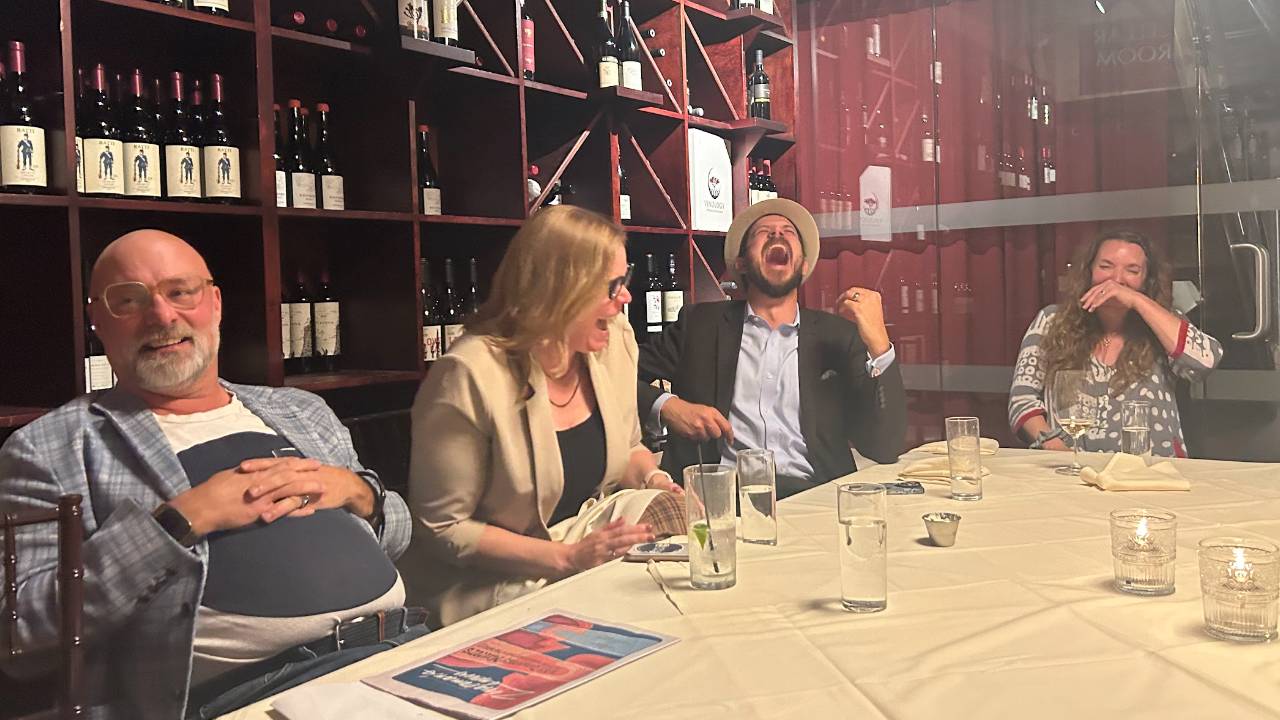
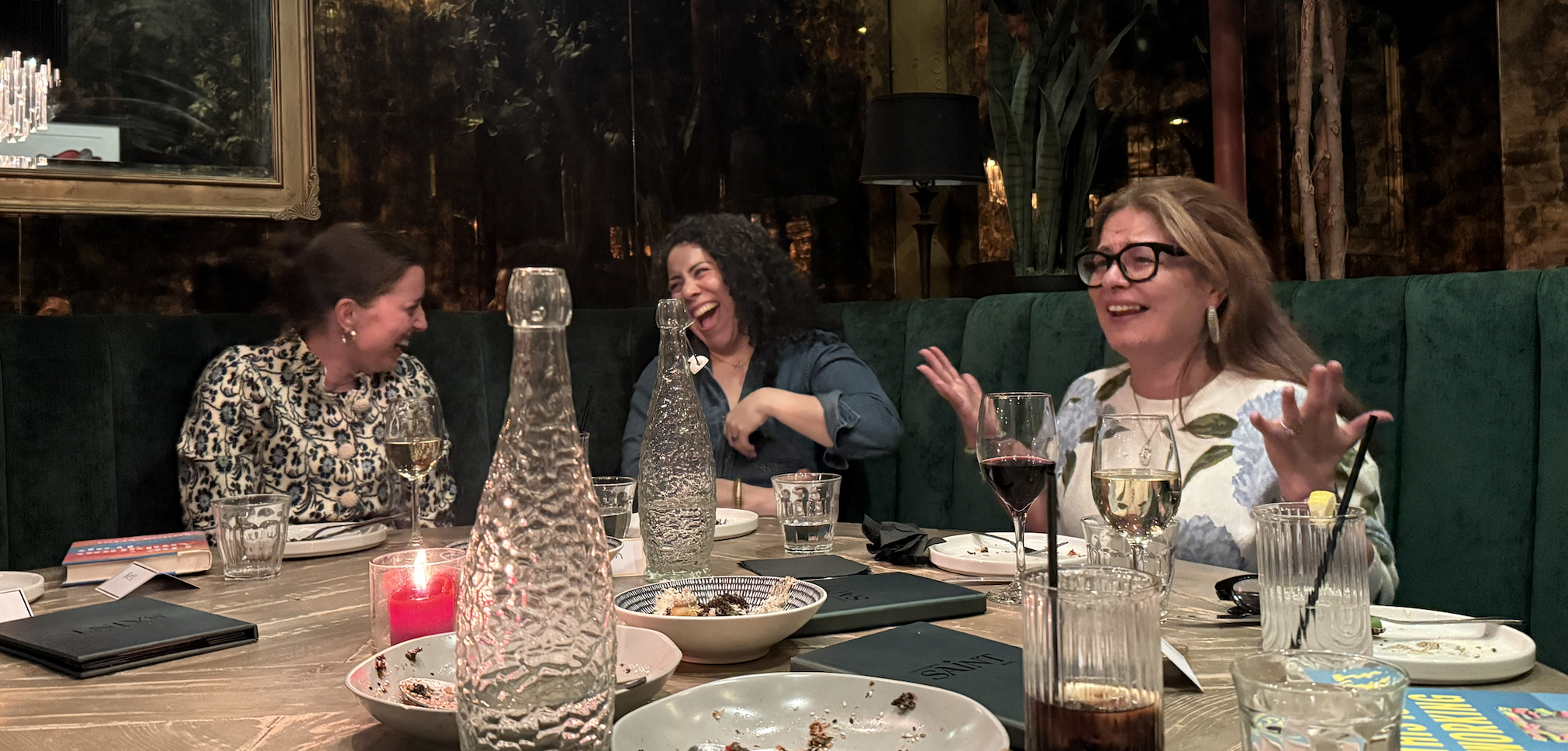
(I mean, when was the last time you felt like👇 this with a group of perfect strangers?)

How to Host a Salon Dinner
Three things make a salon dinner different from a regular dinner party: structure, ground rules, and questions. Get those right and the rest mostly takes care of itself.
1. Set the format up front
When everyone's seated and has a glass of something, take 60 seconds to explain the format:
- "Tonight we're doing a salon dinner — one conversation, the whole table, all the way through."
- "I'll throw out a few questions over the course of the meal. Everyone gets a turn to answer."
- "Phones away, please. We're going to be more present than we usually are at dinner."
The framing tells everyone the rules of the game. Without it, people default to side conversations and the moment evaporates.
2. Set the ground rules
Three rules cover almost every situation:
- Stay present. No phones. No checking the time.
- Listen actively. Don't formulate your response while someone else is talking. Let their answer land.
- No side conversations. When one person is speaking, the table is listening.
You don't have to be heavy-handed about this — most guests are relieved when someone takes the role of facilitator and gives them permission to drop the small talk.
3. Choose your question format
A few options:
- One question for the group. Everyone answers the same prompt. Best for first-time hosts; creates the strongest sense of shared experience.
- Rotating questions. Different questions for different guests. Best for groups who already know each other a bit.
- Themed questions. A run of questions centered on a single topic — first jobs, formative books, a turning point. Best when you want the conversation to go somewhere rather than skip around.
When in doubt, pick one strong question and let everyone answer it. Some of the best salon dinners I've hosted spent two hours on a single question.
6 Questions That Spark Deep Conversation
These are the six questions I've come back to again and again. Each one has been tested across multiple dinners with multiple groups, and each one tends to reliably crack a table open.
1. Tell us about a key turning point in your life — a moment after which everything felt different.
This question invites guests to reflect on pivotal moments that shaped their path. It encourages vulnerability and storytelling, and almost always reveals something the rest of the table didn't know.
2. What's one trait from one of your parents that you hope to emulate?
People love this question. It invites them to honor a parent (or mentor figure) without performing — and you almost always learn something tender about the speaker by hearing what they admire.
3. What's something you've felt deeply passionate about in your life and why?
Passion fuels purpose. This question lets guests share what lights them up, providing insight into what drives them and what makes them feel alive. It's also the one that most reliably cuts through small talk.
4. What's a key decision you've made that has shaped your life?
Life is a series of choices, and reflecting on a defining decision allows guests to explore the role of risk, intuition, and timing. It surfaces moments of courage and doubt — and often the quiet ones that turned out to matter most.
5. What's something you wished more people asked you about yourself that they rarely do?
This is the question that frequently makes people cry — gently. It invites guests to name a part of themselves that's been quietly waiting for an audience. Save it for later in the meal once trust has built.
6. Who is one person who has shaped your life in a meaningful way?
This brings up gratitude, mentorship, and impact. Guests reflect on the people who have changed their lives for the better — and frequently, the act of naming them out loud is the first time they've ever done it.
Card Games For Your Hosting Kit
When I want to add an extra spark or shake up a group that's settling in too quickly, I keep a few card games nearby. These three are my favorites:
- Vulnerability Is Sexy Card Game by my friend Corey Blake — a staple. The questions reliably move groups toward real connection.
- Where Should We Begin: A Game of Stories by psychotherapist Esther Perel — beautiful prompts that help groups talk about what actually matters.
- Find Your Moonshot Game by Jeremy DeRuiter — questions focused on dreams, ambitions, and life goals. Great for groups who already know each other and want to go deeper.
A Few Last Things
The hardest part of hosting a salon dinner is sending the first invitation. The second-hardest part is realizing how much you've been missing.
I've done this enough times now to say with confidence: people are hungry for this. They don't know how to ask for it, they don't know how to set it up, and they don't know how to invite it without feeling weird. So you have to be the one who does it — send the invitation, explain the format, ask the question.
Most of my closest friendships started at someone else's salon dinner. The rest started at one of my own.
Want to Keep Going?
If this resonated and you want to take a crack at hosting your own dinner, feel free to download my free guide that will help you with everything from table set-up, what to say to your guests, and even how to handle common pitfalls. Grab your Salon Dinner Host Kit here.
And if you want to go deeper, my book "This Isn't Working" goes into the research behind connection, community, and why so many of us are quietly burned out, or you can also sign up for my Substack for regular doses of good stuff👇.
Want More Where This Came From?
Grab my free 7-insight summary of "This Isn't Working"—click the button below and I'll send it over. You'll also get my Substack essays twice a month: long-form thinking on work, leadership, and building a life that doesn't break you. Inboxes are sacred. I will not waste yours.
Or you can jump directly into: 📖 The book · 🎙️ The Unbehaved Podcast · 📬 The Unbehaved Substack
